
Welcome to our series, Made with Moodle. Every month, we spotlight someone using the Moodle platform in creative, impactful ways. Have a story of your own? We’d love to hear it.
“Thoughtful design really does change the learning experience — in ways people don’t always see.”
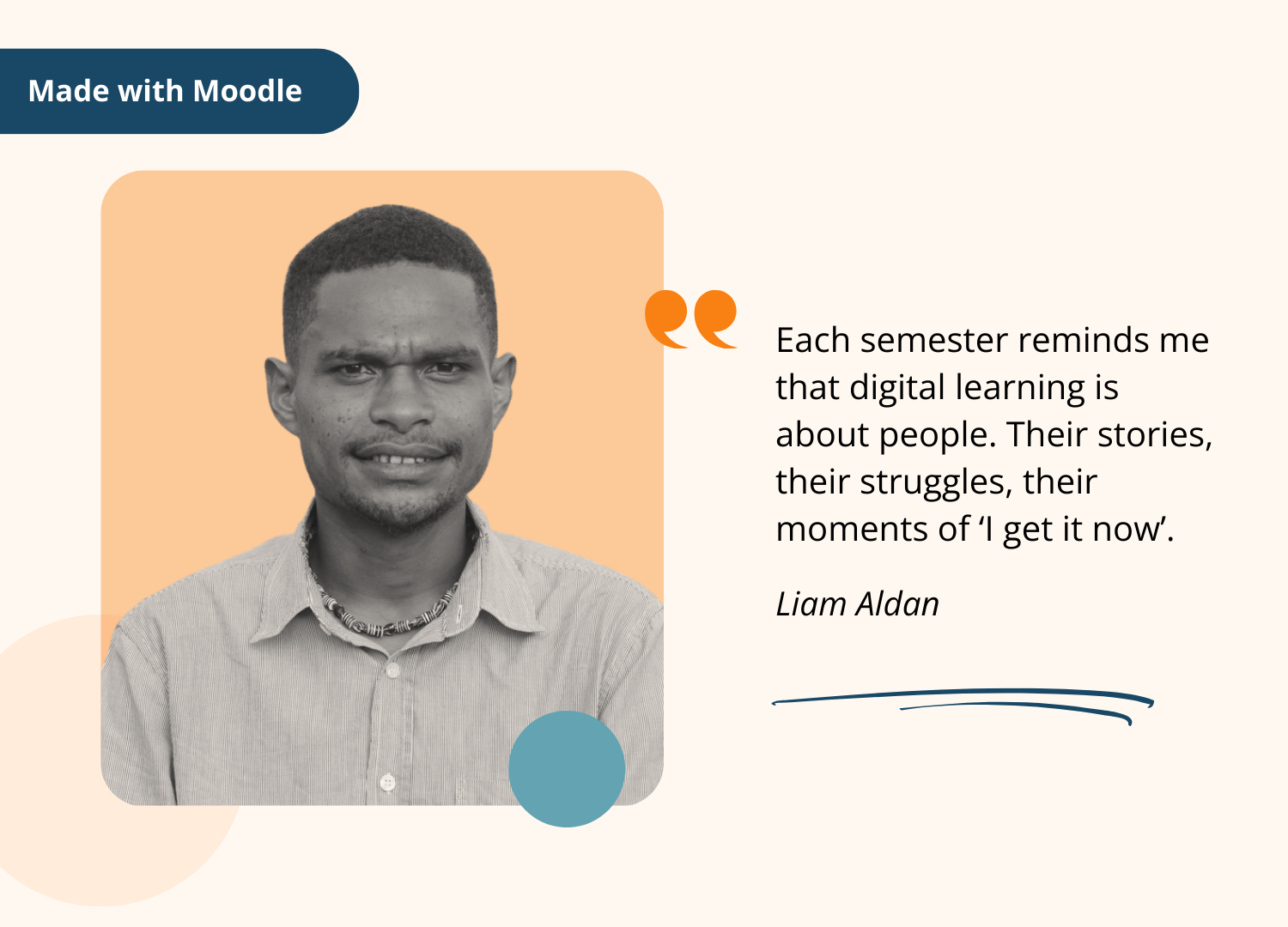
Liam Aldan’s learning design journey didn’t begin with a map. There was no grand plan — at least not at first. Instead, driven by curiosity and the desire to help support students, he followed a path that led him to design and build a stronger online learning environment.
“When I look back, it’s hard to believe that this year marks my fourth year as a Moodle Learning Designer at Divine Word University,” he says.
In Liam’s early days at the university in Papua New Guinea, he remembers opening digital courses that “felt like long corridors with closed doors”. The information was there, but students didn’t always know what to do with it — or where to go next. Meanwhile, lecturers had limited time to create engaging courses with Moodle LMS or refine the ones they were already using. Liam realised that to make a meaningful impact, he’d have to shift his mindset from “designing courses” to “designing clear, meaningful learning experiences”.
“I began working with academic staff — listening to their challenges and learning their teaching styles,” says Liam. Then he used his insights to build digital environments that students could navigate easily. He also began helping his colleagues understand the options available to them in Moodle LMS by training and supporting them through course design.
Slowly but surely, the university’s Moodle site became a vibrant learning space. Diverse learners with different levels of access and digital literacy began to benefit from a more welcoming, intuitive online environment.
Liam remembers feeling the platform come to life. “Each course I redesigned felt like opening a window — more light, more structure, more room for engagement,” he says. “First‑year students who once felt lost now knew exactly where to begin. Lecturers who’d been overwhelmed by technology suddenly felt inspired, empowered.”
Course forums became active spaces for real conversation. Courses grew richer and more immersive, with interactive elements — videos, quizzes and presentations — adding vibrancy and encouraging engagement.
For Liam, these early changes were just the beginning.
“My work has grown into building consistent templates, weaving in multimedia, improving assessments, and helping staff rethink what online learning could look like,” says Liam. “And each semester reminds me that digital learning is about people. Their stories, their struggles, their moments of ‘I get it now.’”
When Liam joined Divine Word University, he encountered a system that had been running for years, filled with courses shaped by many different hands and teaching styles. Instead of starting fresh, his work became about honouring what already existed while helping it evolve into something even better.
“There was a moment — one I still think about — when a first‑year student told me, ‘I actually understand where everything is now,’” he says. “Just a few simple words, but to me, they meant everything. Thoughtful design really does change the learning experience — in ways people don’t always see.”