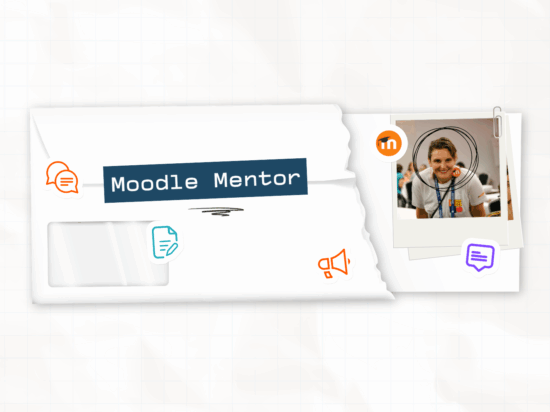
Welcome to our series, Made with Moodle. Every month, we spotlight someone using the Moodle platform in creative, impactful ways. Have a story of your own? We’d love to hear it.
“In short: we used what worked.”

Sandro Pettineo is a listener. He’s thoughtful and practical with a natural problem-solving instinct, which reveals itself in the way he talks with people — quietly, patiently, always trying to understand what they really need before offering a solution.
Fortunately, Sandro’s reflective nature fits his role like a glove. At the International Training Centre of the International Labour Organization (ITCILO) in Turin, he designs meaningful training and development programmes that empower learners and help organisations become more robust partners in economic and social development across regions.
“We work with employers and business membership organisations — EBMOs — and the private sector,” says Sandro, explaining that ITCILO’s Programme for Employers’ Activities’ (PEA) mission is to create conditions that support long-term, sustainable growth worldwide.
By the time Sandro joined ITCILO, Moodle LMS had been the backbone of the institution’s learning system, eCampus, for years. Then, in early 2020, COVID-19 hit. Italy was one of the countries affected almost immediately, and travel restrictions forced the team to rethink how they delivered training.
“Suddenly, we couldn’t hold face-to-face sessions,” Sandro recalls. “Instead, we had to create digital activities that were aesthetically pleasing, engaging, and interactive — and Moodle became critical.”
One of the first organisations to turn to him was the Employers Confederation of the Philippines (ECOP), an EBMO already collaborating with ITCILO. The challenge was urgent: the Philippines is an archipelago of more than 7,000 islands, and travel restrictions meant that ECOP’s members could no longer attend in-person programs.
They needed a solution — and fast. Sandro proposed setting up a Moodle-based learning platform for ECOP. The idea was simple, but powerful: give members access to training anywhere, anytime, leveraging Moodle, which they were already familiar with because of ITCILO’s eCampus.
The results were resoundingly positive. Members stayed engaged, and ECOP remained relevant and profitable while their Moodle-based platform became a space for genuine innovation.
“My familiarity with Moodle LMS meant I could move fast when the need for digital training solutions became urgent,” says Sandro. “In short: we used what worked, and what we knew our partners could quickly adapt to.”
At the height of the global pandemic, this success set a new precedent for online learning at ITCILO. Other EBMOs began to see the potential of their own platforms, recognising the benefits of adding a digital component to their training programme.
Since 2020, Sandro has helped build and roll out Moodle LMS platforms for more than 40 organisations across Central and Latin America, Europe, Asia, the Arab States, and Africa. Each organisation has its own culture and needs, which makes the work exciting — no two solutions are exactly the same.
“Based on that experience, I developed a hands-on training programme to help EBMOs manage their Moodle-based platforms,” says Sandro. “Participants go through weekly challenges to create their own courses, experiment with authoring tools like H5P, Genially, and Articulate, and learn how to apply training methodologies that work in both online and face-to-face settings.”
For Sandro and his colleagues, Moodle LMS has grown into a space for creativity and fresh thinking, helping them transform learning for partners all over the globe.
“What started as an emergency response has become one of our department’s flagship programmes,” explains Sandro. “It’s opened the door to something much, much bigger.”