
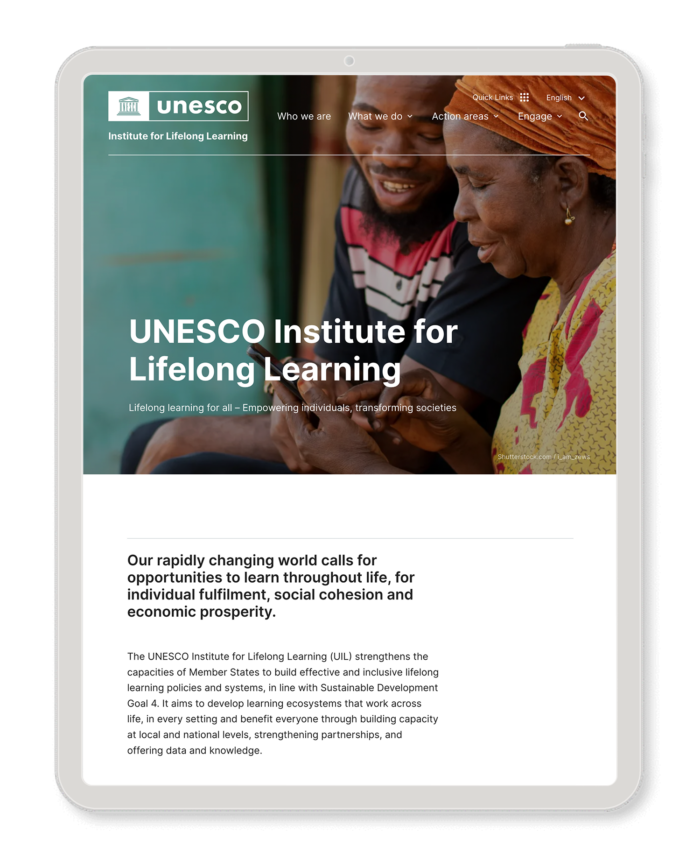
Headquartered in Paris, the United Nations Education, Scientific and Cultural Organisation (UNESCO) is an intergovernmental organisation that was founded in 1945. The UNESCO Institute for Lifelong Learning (UIL) is a global centre of excellence and the only organisation in the UNESCO family with a specific mandate to promote lifelong learning.
UIL strengthens countries’ capacities to build effective and inclusive lifelong learning policies and systems. It aims to develop learning ecosystems that work across life in every setting, benefiting everyone through building capacity at local and national levels, strengthening partnerships, and offering data and knowledge.
Scaling digital skills for literacy educators
UIL leads an initiative to deliver digital skills training for literacy educators, developed in collaboration with the Global Alliance for Literacy and UNESCO’s Global Education Coalition.
The programme aims to strengthen literacy outcomes by helping educators use technology more effectively — both in everyday teaching and during times of disruption, such as the COVID-19 pandemic. Its ambition is to train 100,000 educators across at least ten participating countries.
In early 2022, UIL created a suite of digital skills modules tailored specifically for adult learners. Designed for flexibility, the course can be adapted and delivered locally across diverse contexts. Built on the open-source Moodle LMS, it enables countries to host and roll out training using local expertise and limited resources. The platform is also optimised for mobile use and low-bandwidth environments, ensuring it remains accessible to those who need it most. Moodle, a UNESCO Global Education Coalition partner, supported the development of the course platform for this initiative.
A global training platform built on Moodle LMS
UIL partnered with Moodle Services to design and deliver a global course using Moodle LMS. The result is an open-source, easy-to-use platform that allows UIL to share digital skills training with literacy educators worldwide, while still adapting content to local contexts and needs.
The course is designed for adult literacy educators across the Global Alliance for Literacy network. It is currently available in English, Arabic, French and Bangla, with Bangladesh, Côte d’Ivoire, Egypt and Nigeria already delivering the modules — and more countries set to follow.
Moodle LMS has proven highly adaptable to UIL’s requirements, offering features such as a print-to-PDF add-on, a customised Database tool for portfolio creation, and built-in offline access via the Moodle App. Most importantly, its intuitive interface makes it accessible for educators who may have little or no prior experience with learning management systems.
Expanding impact and building capacity worldwide
The project has already delivered strong results, with UIL continuing to expand the initiative into new countries. In Egypt, the team introduced the Moodle-based UIL Learning Hub to officials from the Adult Education Authority (AEA) through a dedicated orientation. This effort complemented support from UNESCO Cairo’s Moodle expert, who worked closely with the AEA to implement and run the platform. As a result, the AEA now operates its own platform hosting the Arabic version of the digital skills training modules.
“Before I joined this training, I wasn’t aware of the millions of learning opportunities that are available online. I will buy a computer today and see a new future waiting for me,” said Mona Khalaf, who took the UIL-UNESCO technology training for literacy educators in Egypt.