
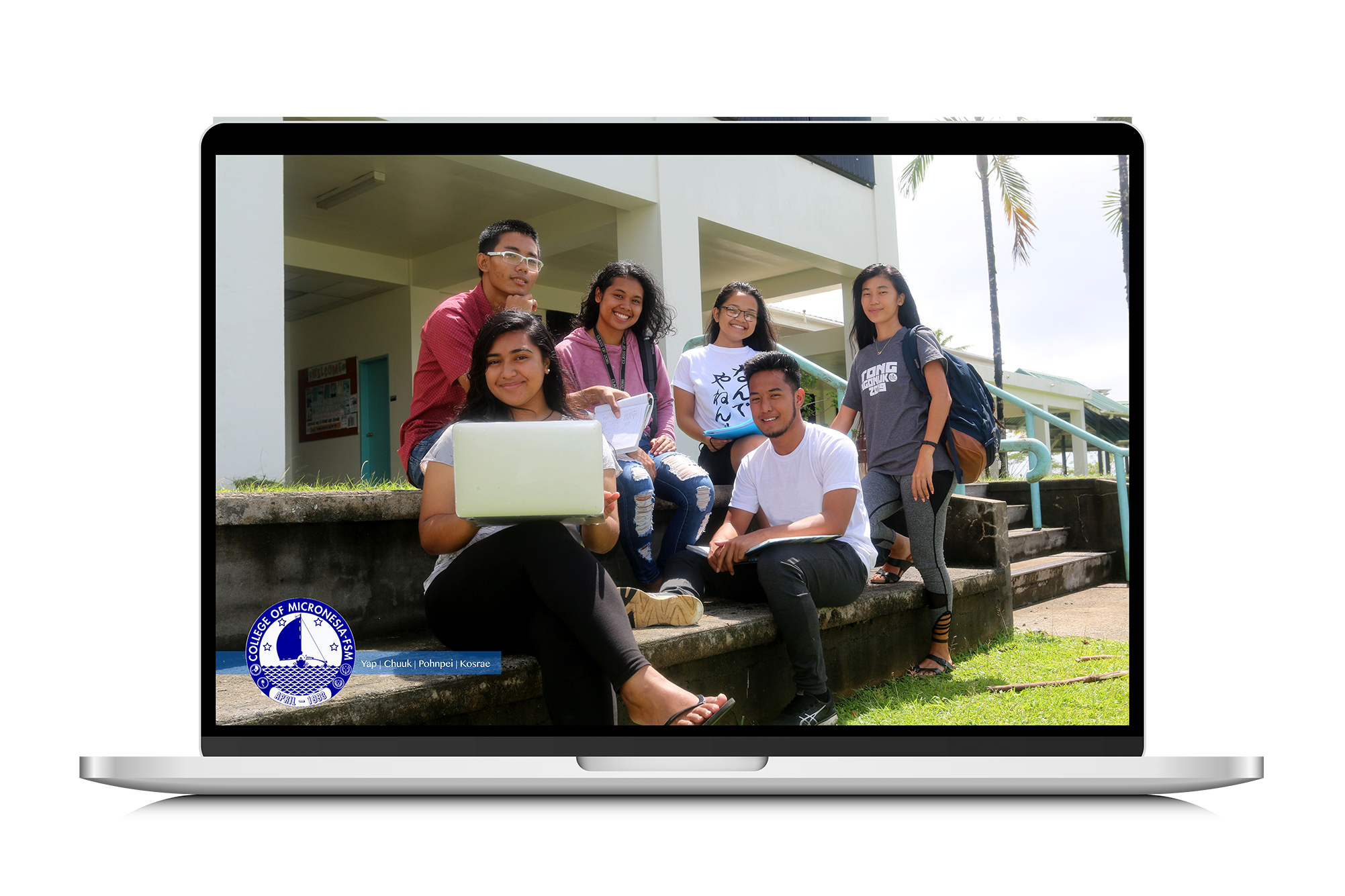
Educating students across a remote Pacific archipelago is no small feat. The College of Micronesia-FSM (COM-FSM) serves around 1,721 students (during its busiest semester) across four island states — Pohnpei, Kosrae, Chuuk, and Yap — distributed over 1.2 million square miles of ocean with many living on one of the many outer islands and atolls that make up Micronesia, travelling to campus by boat, or studying entirely remotely. The College offers a wide range of programs from Business Administration and Nursing to Computing and Carpentry, training the Federated States of Micronesia’s workforce as the only National college.
With a student body this widely distributed, online learning is essential. And for the incoming IT college consultant and Acting Director of IT, Dhiraj Bhartu, finding the right platform to carry it out effectively had been a long time coming.
For Dhiraj, switching to Moodle LMS was a chance to build a learning management system that truly aligned with the College’s strategic goals of access, innovation and resilience in higher education.
A platform that wasn’t keeping pace
COM-FSM’s previous LMS was reliable enough, but it was holding the college back in ways that mattered. Licensing costs were putting pressure on an already stretched budget. The platform couldn’t support local accounts for new staff who didn’t yet have a college domain, making it difficult to onboard people before they officially joined. And community courses — open to anyone beyond the college — were off the table entirely, because the system required an official college email address to access. For a college with ambitions to serve the wider community, that was a real barrier. Courses like Robotics, Physics for High School students and digital literacy programmes covering everything from online safety to working with computers were sitting ready to go — but couldn’t be opened to the people who needed them most.
This point sat uncomfortably with the college’s ethos. COM-FSM’s strategic plan is built around three pillars: access, innovation and resilience. A platform that limited who could learn, and how, wasn’t aligned with any of them.
There were other frustrations as well. The college’s existing process for students to evaluate their favorite academics relied entirely on paper forms — collected, collated and processed by hand. IT consultant Bhartu had previously built a slick digital version of this process using Moodle at another institution, and wanted to do the same here. But the equivalent tool in their current LMS sat behind a paywall. The college needed a system that would let them modernize without constantly hitting a ceiling.
Moodle, I’m home!
Bhartu had used the Moodle LMS back in 2002. He’d grown it from a pilot at the University of the South Pacific and later introduced it across all schools in Fiji while working for the Ministry of Education (Fiji). When COM-FSM came looking for a new platform, it wasn’t a difficult conversation. The college president had come from an institution already using Moodle, and several connected colleges across the north Pacific — including the College of the Marshall Islands, the University of Guam, and the Community College of Palau — were on it too. For students moving between institutions, that continuity was a huge plus.
“It was like coming home,” says Bhartu.
Installing, operating and managing the system across its own infrastructure, the team had everything migrated within four months — no small achievement given the scale of the move. Bhartu took on much of the heavy lifting himself, getting course content in and giving staff the confidence they needed to get started. Furthermore, COM-FSM established an Instructional Design unit at the same time with an Education Technologist being trained by a short-term Instructional Design consultant to provide institutional learning design services especially to faculty and students.
Moodle Academy filled in the gaps, providing a library of videos and resources to explore at their own pace — trying out different designs, experimenting with layouts and making their courses feel like their own. For a team navigating a significant change, knowing that expert partner support was available if needed made a real difference.
Winning over the sceptics
Even the best changes meet with some friction. Some faculty members had been using a different system for two and a half years, and the prospect of another change didn’t go down well with everyone. Bhartu set up a sandbox environment where staff could explore the platform and flag any difficulties before the move was complete. He ran live workshops supported by the Education Technologist where academics built out real courses they’d actually be delivering the following term — learning and achieving at the same time. Training was extended to student counsellors and IT staff across each of the regional state campuses. And with full backing from senior management, the college offered incentives to staff who completed the transition.
It worked. And the results, when they came, went beyond what anyone had expected.
Discussion forums — rarely used in the previous system — became one of the most popular features almost immediately. Faculty use them for Q&As, open discussions and peer reviews, with students engaging across campuses in ways the old platform never made possible.
For example, one forum requires students to reflect on their research proposals before moving into the drafting stage — sharing the challenges they’ve encountered, the lessons learned and how they plan to move forward. Classmates respond to each other’s posts, turning what might otherwise be an isolated piece of work into a genuine class discussion. It’s a small but telling example of how the forums have shifted the feel of learning at COM-FSM — from students working alone across scattered islands, to a community working through things together.
“It’s opened up a whole new world of education technology for people who might not even have thought that they could do that,” says Bhartu. “With discussion forums, people are feeling a bit more connected with one another across a really wide area.”
One moment captures it well. A long-serving faculty member — initially hesitant, used to simply uploading notes and setting assignments — is now designing quizzes, running forum discussions and using Moodle LMS’s rubrics feature to assess her students. “She’s just totally flying with it,” says Bhartu.
Built for access, innovation and resilience
Today, Moodle sits at the heart of how COM-FSM plans for what comes next. Community courses are now open to anyone, with access managed through connected accounts rather than official college email addresses, giving the college a way to serve the wider community without compromising security or control.
Bhartu is already exploring AI integration, experimenting with connecting Moodle’s analytics to emerging tools that could further personalize learning. The college’s 2025–2030 Strategic Plan — built around access, innovation, and resilience — maps directly onto what open source makes possible: the flexibility to adapt, the ability to integrate new tools and the financial sustainability to keep growing without being tied to expensive licensing.
Advice for anyone considering Moodle
Today, Moodle sits at the heart of how COM-FSM plans for what comes next. Community courses are now open to anyone, with access managed through connected accounts rather than official college email addresses, giving the college a way to serve the wider community without compromising security or control.
Bhartu is already exploring AI integration, experimenting with connecting Moodle’s analytics to emerging tools that could further personalize learning. The college’s 2025–2030 Strategic Plan — built around access, innovation, and resilience — maps directly onto what open source makes possible: the flexibility to adapt, the ability to integrate new tools and the financial sustainability to keep growing without being tied to expensive licensing.
Advice for anyone considering Moodle
For institutions weighing up a similar transition, Bhartu’s advice is straightforward:
- Give yourself time. Ideally a year or more, depending on the size of your course catalogue and student body. A rushed migration creates frustration for faculty already managing a full teaching load.
- Map out clear milestones. Align them with quieter periods in the academic calendar so faculty have the breathing room to transition properly.
- Keep communicating. You cannot create a silo where you are moving forward but everyone else is in the dark. Keep faculty informed throughout and give them space to raise concerns and explore the platform at their own pace.
- Get senior management on board early. Their backing — and their willingness to back it up with real commitment — makes a significant difference to how the rest of the institution responds.
- Make sure you have someone in your corner. Whether that’s an internal expert or a Moodle Certified Partner, having someone who can do the heavy lifting and offer reassurance is what turns a stressful transition into a manageable one.
To learn a little more about our platform, connect with a Moodle expert who can guide you through your options — whether you’re migrating, upgrading or simply exploring.