

When the pandemic hit in March 2020, Kuwait University found itself in challenging circumstances. With exams around the corner and students suddenly unable to attend in person, the institution had less than a week to build an online learning environment capable of supporting nearly 50,000 users.
To do this, KU needed to move from one learning management system to another — a process which, under any other circumstances, would take months.
The team had just four days. Fortunately, they also had a plan, and a partner in mind to help them make it a reality.
Four days to implement virtual learning
When it was founded in 1966, Kuwait University had a cohort of just 418 students and 31 faculty members. Now, nearly 45,000 learners attend the institution every year, and faculty number more than 1,600.
Driven by a strategic plan broken into four key priorities — quality, sustainability, innovation and global visibility — the university is a lively, innovative place to study. Learners can choose from 76 undergraduate and 95 graduate programmes across disciplines including engineering, medicine, business, education, law, computing, the humanities and the sciences. Every year, 5,000 new graduates join over 100,000 KU alumni already making a difference across the region.
In 2019, the university consolidated six of its campuses into one central hub, Sabah Alsalem University City campus in Al-Shadadiya, as part of its new growth strategy. Then, in early 2020, COVID-19 arrived in Kuwait.
Dr Abdullah Muhammad Al Mutawa, Vice President of Academic Support Services at KU, remembers the moment as a tipping point. “We couldn’t take the campus online — our learning management system (LMS) just wasn’t flexible enough.”

KU had to become a remote learning facility immediately. More than that, the institution’s new LMS had to integrate with existing systems and support learning long after the pandemic passed. For Dr Mutawa, an international expert on AI whose work at the university included creating and maintaining agile systems, flexibility and long-term sustainability were non-negotiable.
In the end, the university turned to a platform it already used at its College of Engineering: Moodle LMS. Working alongside Moodle Premium Certified Partner Human Logic, KU successfully moved its courses from Blackboard to Moodle LMS in just 48 hours, leaving the university another two days to test the system before taking it live.
“When we asked Human Logic for help, they said, ‘Okay — we’re going to get this done.’ And they did,” remembers Dr Mutawa. “It was a tremendous achievement.”
Students, faculty and support staff were able to log in, access learning materials from home, and continue their studies. Exams went ahead as planned, and students graduated during one of the most disruptive periods in modern education.
From challenge to long-term change
With Moodle LMS in place, Kuwait University is more accessible than ever — especially for students who can’t easily attend campus. New, flexible ways of learning have given students greater freedom to access course materials, assessments and recorded lectures in ways that work for them.
For Dr Mutawa, much of that flexibility comes from Moodle LMS’s open-source foundation and friendly community.
“We can always contribute,” he says. “I can go to Moodle.org, suggest a plugin, make it myself and provide it to others. It’s like a worldwide family.”
Dr Mutawa names Moodle Workshop — a long-standing peer assessment tool that allows students to review and grade each other’s work — as one of his favourite activities. KU faculty also like the drag-and-drop features introduced in newer versions of Moodle LMS, which make it much simpler to arrange items within courses.
Recently, students had to attend classes remotely once again because of geo-political tensions in the Middle East, but this time, KU had the infrastructure to support digital learning at scale. So, they were able to switch from in-person to virtual lectures straight away. Dr Mutawa proudly describes this as the “second wave of online education” for the university.
Welcoming AI into the classroom
As one of the international experts involved in UNESCO’s work on the ethics of artificial intelligence, Dr Mutawa has been speaking and writing about AI for more than 25 years. Having watched the technology evolve over decades, he believes it has enormous potential to improve education and help institutions remain relevant as student needs evolve.
“AI is a new way of life, and it has to become second nature,” he urges. “If we don’t make it part of the educational environment, that environment will become outdated.”
At KU, Dr Mutawa and his team are already putting this philosophy into practice. Custom Moodle LMS plugins designed by Human Logic — including a bilingual Arabic-English chatbot and an auto-grading tool for instant feedback on assignments — power the university’s AI-integrated learning environment. Faculty can also use an AI-driven insights tool to help them understand how students are doing in class.
Of all the university’s AI tools, Dr Mutawa is most excited by the AI-powered quiz generator, which he describes as “amazing”. Aligned with Bloom’s Taxonomy, the plugin produces questions that test knowledge, critical thinking, analysis, and problem-solving across different levels of learning.
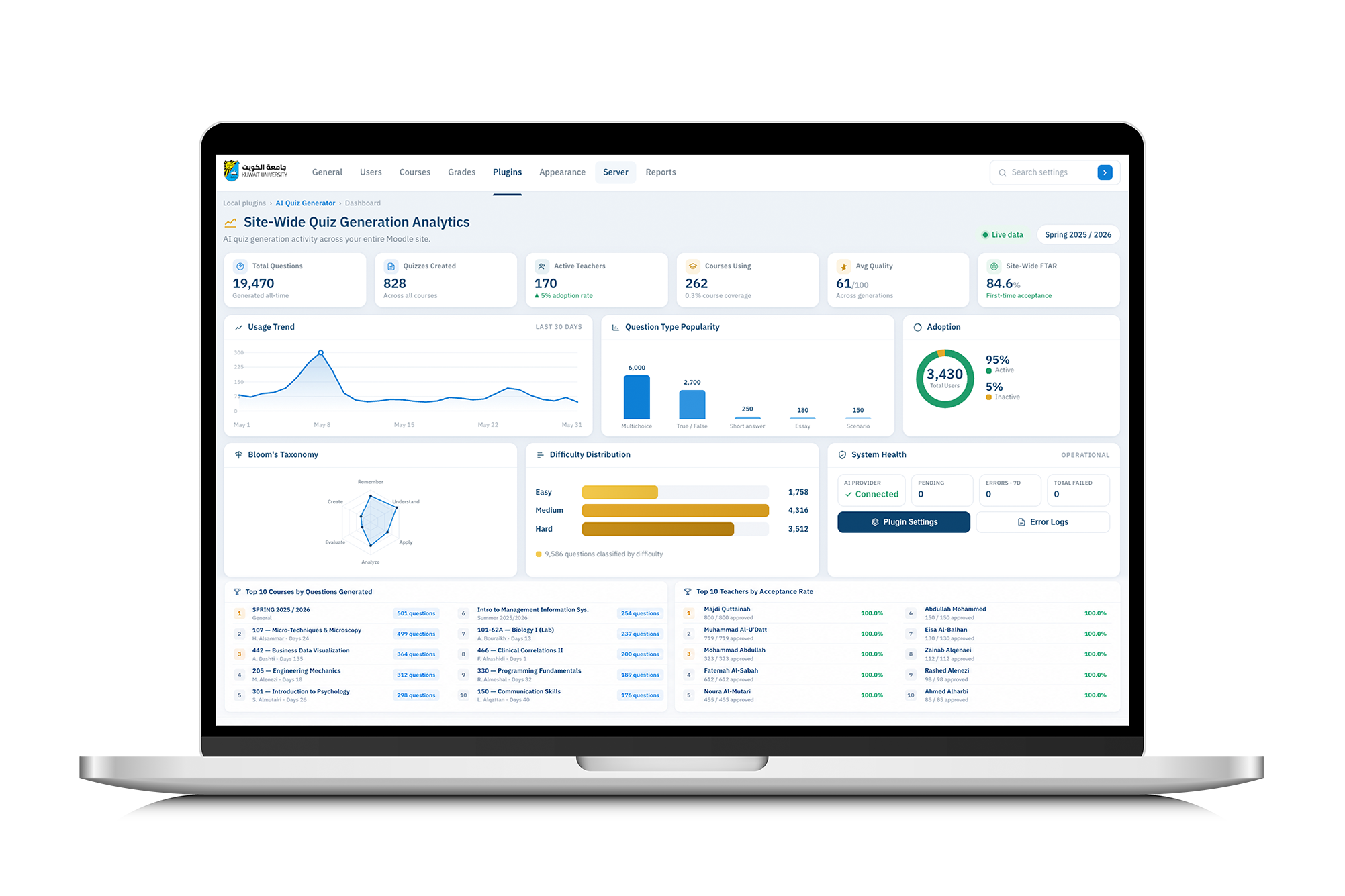
“With the help of AI, the instructor’s role is not to generate the questions, but to validate them,” he explains. “This means we can ask more sophisticated questions that cover the curriculum in greater depth.”
This approach gives the university much clearer insight into how students are assessed. By connecting the learning environment with KPIs, the KU team can gauge how well courses are going, better understand what’s working for students, and identify ways to improve the learning experience.
Moodle LMS beyond higher education
Beyond the classroom, Kuwait University also uses the Moodle platform to run aptitude tests — both for prospective students and for regional organisations looking to hire new employees. These custom installations (again, engineered by Human Logic) are completely separate from the university’s main learning environment, allowing KU to manage large-scale testing in a secure, efficient way.
Powered by Moodle LMS, the first installation supports learning and assessment for admissions-related processes at Kuwait University, where the acceptance ratio averages one place for every seven applications. Three times a year, as many as 10,000 applicants complete an aptitude test, with grades automatically generated and included in admissions decisions.
About three years ago, KU launched a second aptitude-testing solution for large public-sector organisations across the Gulf region, this time built with Moodle Workplace. Employers are given individual tenancies tailored to their industries and hiring needs; candidates complete assessments within those portals as part of the recruitment process, with results sent directly back to the organisations.
Both systems are easy for candidates to use.”There are no lectures or homework,” says Dr Mutawa. “A student or user logs in, takes the test, gets the grade and exits. It’s that simple.”
Planning for the future
Crisis creates change — and for Kuwait University, the arrival of COVID-19 meant finding a way to move from one learning management system to another in less than a week. But for Dr Mutawa and his team, the disruption also created an opportunity to introduce tools and ways of learning that would continue shaping the university long after the pandemic had passed.
As Dr Mutawa points out, progress never stops. The university’s next focus is the Moodle App, as KU explores how to create learning experiences that feel more natural for students who increasingly live, communicate and learn through mobile devices and short-form digital content.
“Now all courses are recorded, we have a database of material we can turn into bite-sized videos,” he explains. “For example, a 50-minute lecture could become three shorter videos and an AI summary.”
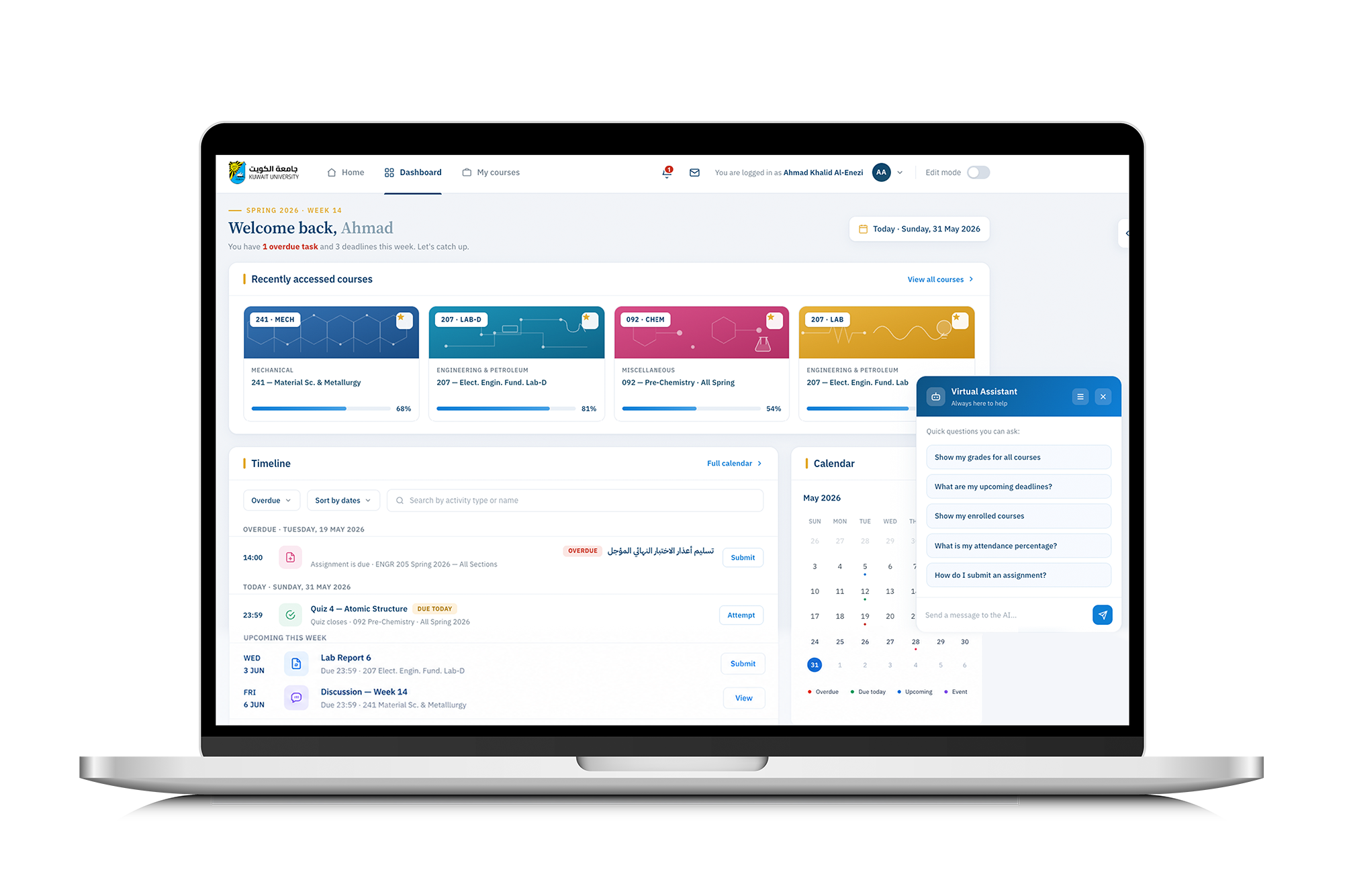
From microlearning to artificial intelligence and beyond, Dr Mutawa and his team are excited for the future at KU.
“I think it’s wise to look at what’s happening in the world and think in futuristic terms,” he muses. “Our partnership with Human Logic has produced a genuinely flexible Moodle platform, which will adapt to new technologies as they emerge. We’re really pleased with it.”
Human Logic is equally optimistic about what comes next.
“Universities are beginning to see just how flexible Moodle solutions can be, and how effectively they can support the complex needs of higher education institutions,” says Human Logic Head of Projects, Mrudula Gummuluri.”That trust pushes us to innovate, helping universities build powerful learning environments that can evolve and remain sustainable long into the future.”
Together, Kuwait University and Human Logic are continuing to explore what modern digital education can become — not only for higher education institutions, but for the wider world of learning and assessment across the Gulf region.
To learn more about Moodle solutions, connect with an expert who can guide you through your options — whether you’re migrating, upgrading or simply exploring.