
Cegos Group has been helping international organisations with ready-made training courses and customised learning solutions since 1926. Since its foundation in France, the organisation has expanded to approximately 50 countries, training over 250,000 learners annually in more than 20 languages.
Cegos Portugal Digital Studio, which sits within the Cegos Group’s Portuguese subsidiary (CEGOC), specialises in designing, developing, producing and delivering high-impact digital and in-person learning experiences. The studio needed a more flexible and scalable solution that could be personalised to provide a better user experience while also delivering excellent service on an international scale.
Recently, Lídia Fernandes (Manager of E-Services) and Nuno Moreira (Head of E-Services) from CEGOS Group explained how they chose the right LMS for their needs.
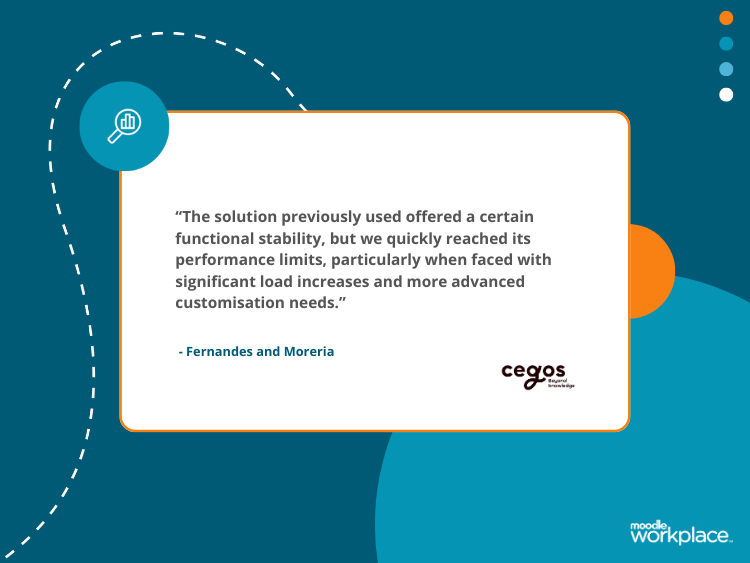
According to Fernandes and Moriera, Cegos’ previous LMS provided a stable foundation, but as their needs evolved, its limitations became increasingly clear. As learner numbers grew and expectations shifted, the platform struggled to keep pace — particularly when it came to handling higher demand and supporting more advanced levels of customisation.
Over time, technical constraints also began to slow progress. The complexity of the system made it harder to roll out updates, integrate new features, and respond to emerging digital learning standards. What once worked well was no longer enough for an organisation operating at scale, prompting Cegos to seek a more flexible, future-ready solution.
What would an ideal LMS look like?
The organisation had a clear vision of what it needed from a new LMS — one that could meet a wide range of business, educational and technical requirements. With this in mind, several platforms were evaluated against key criteria, including customisation capabilities, performance in international environments, scalability for a growing learner base, and compatibility with existing internal systems.
Against these requirements, Moodle Workplace quickly stood out as the ideal fit. As Fernandes and Moreira explained, “This choice is explained by several key factors: its exceptional flexibility, which allows for fine-tuning to each local context; its modularity, which facilitates multi-entity management and the integration of multilingual content; and its ability to evolve rapidly, by integrating new digital learning practices, such as adaptive learning, gamification and even path automation.”
They also highlighted Moodle Workplace’s ability to integrate seamlessly with their wider ecosystem — working smoothly alongside internal tools, external platforms and local information systems.
Addressing the diversity of needs
When it comes to international education, every country has its unique preferences. These can be linguistic, technical or distinct pedagogical approaches that are directly linked to the country’s culture and operational practices.
To meet these diverse needs, Moodle Premium Certified Partner Edunao supported Cegos in deploying multi-country platforms tailored to each context. As Fernandes and Moreira explained, “they offered us robust and agile technical solutions: fine-grained management of tenants, customisation of user roles, automation of registration flows, centralised management of multilingual content and tailor-made dashboards.”
With Moodle Workplace’s multi-tenancy feature, each entity can create an environment tailored to local needs while staying connected to a unified global platform. This approach allows Cegos to balance local flexibility with central oversight, streamlining management and supporting the platform’s ongoing evolution.
Personalised learning pathways at scale
One of the most powerful changes for Cegos has been the ability to personalise learning journeys for each user, at scale.
With their previous platform, personalisation relied on learners completing a test before they could access a tailored learning path. Now, with Moodle Workplace and support from Edunao, Cegos has streamlined the process. Each learner is automatically enrolled on a personalised training journey — no manual steps or placement quizzes required.
As Fernandes and Moreira explain, this shift brought “a real gain in fluidity and pedagogical effectiveness”, delivering the right learning to the right person, right when they need it.
Looking ahead, Cegos plans to continue evolving its digital learning experience to meet the needs of modern learners. With a strong foundation in place, the team is already exploring enhancements — including artificial intelligence tools and gamification — to further personalise and enrich the learning experience.
Learning made better for everyone
What Cegos has achieved with Moodle Workplace and Edunao goes far beyond a platform change. They’ve created a more flexible, scalable learning environment: one that supports personalised experiences, simplifies complexity, and is ready to evolve with their needs.
It’s a reminder that when learning spans countries, contexts and cultures, the right combination of technology and partnership matters. With the right foundation in place, organisations can deliver more relevant, effective learning at scale.
Moodle Premium Certified Partners like Edunao play a key role in making that possible. They work alongside teams to shape the platform around real goals — from technical setup to automation and continuous improvement — ensuring it delivers value over time.
In the case of Cegos, that’s meant a better learning experience for more than 55,000 users, and they’re only just getting started.